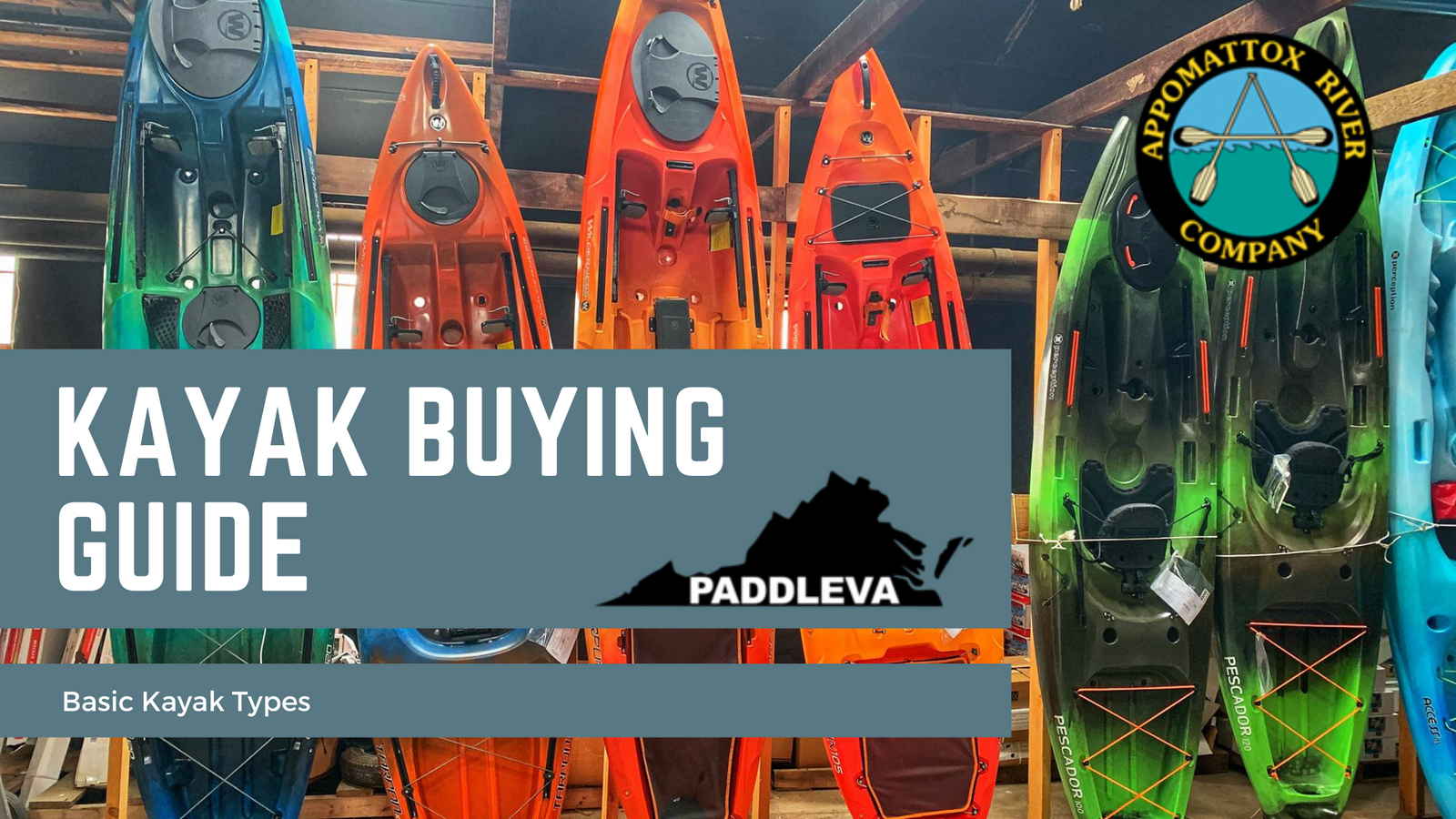
Kayak Buying Guide: Basic Kayak Types
When we started selling canoes in the 1970s, there was no such thing as online ordering. Customers came to Farmville, walked through our warehouse, and our staff found and loaded the perfect boat. Over forty years later, we still love doing that — but with a nationwide customer base and a growing volume of online orders, we wanted to put that same expertise somewhere you can access it from your living room.
Welcome to the Kayak Buying Guide. In this series, we’ll break down the process of choosing a kayak into focused, easy-to-digest topics to help you find your perfect boat. And remember: the people who write these guides are the same ones who answer our phones. If you have questions or need a personal recommendation, give us a call — we’re happy to help.
In this first installment, we tackle the most fundamental question: why are there so many different kinds of kayaks, and which one is right for you?
The short answer: there are so many kayaks because there are so many kinds of water and so many kinds of paddlers. Kayaks are categorized by the type of water or activity they’re designed for. Here’s a breakdown of the main types.
Recreational Kayaks

Recreational kayaks are the most popular on the market — versatile, beginner-friendly, and well suited to calm, flat water like lakes, ponds, and slow rivers. They typically range from 9 to 12 feet long and 25 to 35 inches wide, and weigh between 35 and 70 lbs, making them easy to carry and transport.
Rec kayaks come in both sit-inside and sit-on-top styles. They’re not designed for whitewater or offshore use, and they don’t excel in any single performance category — but that’s the point. They’re the happy medium: comfortable, easy to use, and great for a relaxed day on the water.
Whitewater Kayaks

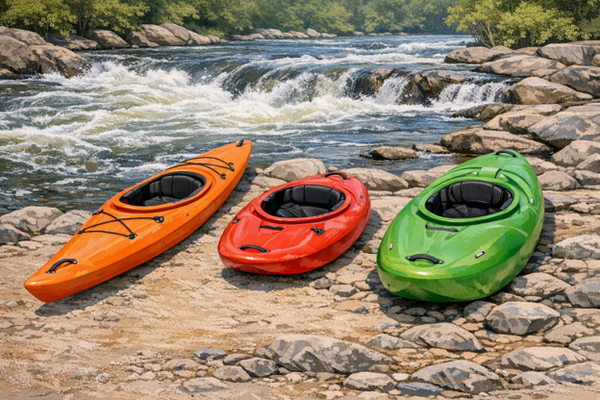
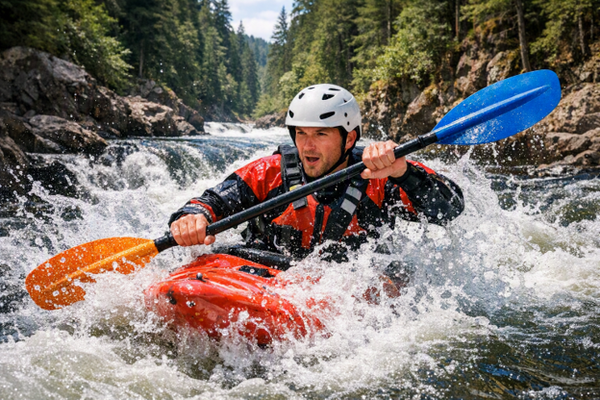
Whitewater kayaks are short, sturdily built, and highly maneuverable. Designed for rapids ranging from Class I to Class V, they’re made from thick, heavy plastic and include safety features like positive flotation, bulkheads, and customizable outfitting. Most fall between 7 and 9 feet, though some 12-foot models are used for racing. Nearly all are sit-inside; a few sit-on-top models exist for Class I–II use.
Whitewater kayaks have snug cockpits and low backbands to accommodate neoprene spray skirts, which keep water out and allow paddlers to roll the boat upright after a capsize — a skill that takes instruction and practice. They’re also outfitted with hip pads, thigh braces, and adjustable bulkheads for maximum hull contact and control. They’re nimble in rapids but slow on flat water and don’t track well in a straight line. Despite their small size, they tend to be heavier than some rec boats due to thicker construction and heavier-duty outfitting.
Touring Kayaks

Touring kayaks are built for multi-day open-water trips. Almost always sit-inside, they typically range from 14 to 17 feet — the longer the boat, the longer the journey it’s capable of. These kayaks prioritize speed, efficiency, and safety over comfort. Like whitewater boats, they feature small cockpits, low backbands, and thigh braces for control and rolling, and are designed to be used with a spray skirt.
Many touring kayaks include drop-down rudders or skegs for improved tracking and efficiency. They typically have a deep V-shaped hull that rounds at the edges, a sharp bow and stern, and often a keel running along the bottom.
Fishing Kayaks

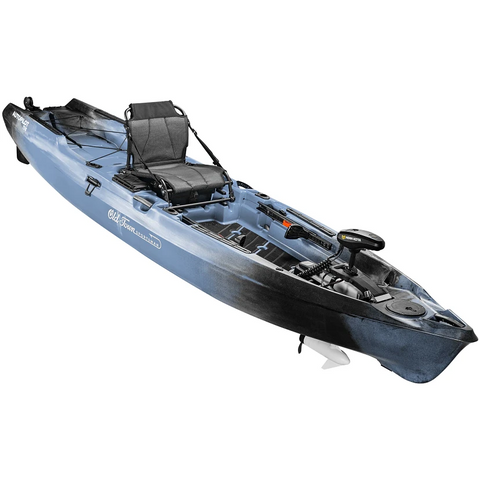
Fishing kayaks are purpose-built for anglers. Most are sit-on-top models between 12 and 14 feet, designed for exceptional stability — most modern fishing kayaks can be stood on. They’re typically wider than rec kayaks with a pontoon-style or W-shaped hull.
Beyond stability, fishing kayaks offer high weight limits, generous storage, and fishing-specific features like rod holders, gear tracks, tackle pockets, and transducer mounts. Supportive frame seats are standard for long days on the water. The trade-off: more stability means more weight. Some fishing kayaks exceed 100 lbs. They’re the best choice for paddlers who plan to spend serious time waiting for fish and want a fully rigged angling platform.
Crossover Kayaks

Crossovers are a broad category covering a wide range of hybrid designs. Some perform well on both flatwater and moderate whitewater; others blend kayak and canoe or kayak and paddleboard characteristics. If you can’t pin down exactly what you’ll be doing — or you paddle a river that’s mostly flat with a few Class II rapids mixed in — a crossover kayak is worth a close look.