Chestnut Canoes: How a Canadian Classic Still Shapes Today’s Canoes
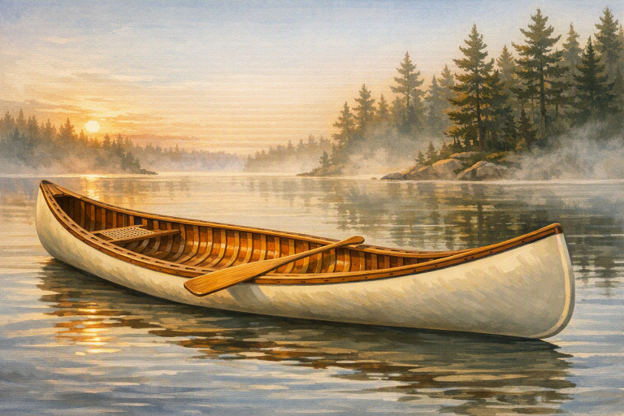
A look at the wood-and-canvas heritage that continues to influence modern canoe design, performance, and identity.

Introduction
Long before lightweight composites and brightly colored recreational hulls filled modern outfitters' racks, the canoe world was shaped by wood, canvas, hand tools, and regional craftsmanship. Few names carry that heritage as strongly as the Chestnut Canoe Company of Fredericton, New Brunswick. From the late nineteenth century until its closure in 1979, Chestnut helped define what many paddlers still imagine when they picture a "real" Canadian canoe: elegant sheer lines, cedar ribs, canvas skin, dependable stability, and a hull built for wilderness travel.
A Company Built on Craftsmanship
Chestnut began marketing canvas canoes in Fredericton in the late 1890s and incorporated as the Chestnut Canoe Company, Limited in 1907. Its early canoes were influenced by established North American wood-and-canvas builders, but Chestnut quickly developed its own reputation for rugged, practical, beautifully proportioned boats. The company survived a major factory fire in 1921, rebuilt, merged into Canadian Watercraft Limited alongside other major canoe makers, and continued producing canoes until the late 1970s.
What made Chestnut canoes special was not simply nostalgia. Their boats were designed for use. Guides, trippers, anglers, survey crews, and families needed canoes that could carry weight, handle moving water, remain stable under load, and be repaired far from a factory. Chestnut's cedar-and-canvas construction delivered exactly that: a strong but flexible hull, a warm wooden interior, and a shape that balanced efficiency with confidence on the water.
The Designs That Became Benchmarks
Several Chestnut models became standards in their own right. The Pal was valued as a versatile recreational canoe. The Bobs Special became known for its manageable size and lighter feel. The Cruiser appealed to paddlers who wanted speed and carrying capacity. The Ogilvy served guides and anglers who needed a stable working platform in shallow rivers. But the most influential Chestnut design may be the Prospector — a canoe type associated with wilderness travel, heavy loads, and dependable performance in varied water conditions.
The Prospector ideal is especially important because it did not disappear with wood-and-canvas construction. Modern canoe builders still use the word "Prospector" to describe versatile tripping canoes with generous depth, good capacity, moderate rocker, and forgiving handling. Even when today's versions are made from fiberglass, Kevlar, carbon fiber, Royalex alternatives, or other composites, the design language often points back to Chestnut's practical wilderness heritage.
How Chestnut Influences Today's Canoes
Chestnut's influence can be seen first in hull shape. Many modern canoe designs still chase the same balance Chestnut achieved: enough beam for stability, enough depth for load carrying, enough rocker for maneuverability, and enough length to travel efficiently. The company's canoes were not abstract engineering exercises; they were working tools shaped by rivers, portages, fish camps, and long trips. That real-world testing is part of why their proportions remain meaningful.
The second influence is philosophical. Chestnut canoes remind modern builders that performance is not only about speed or weight. A good canoe must feel predictable, trustworthy, and useful. Today's lighter materials make portaging easier and maintenance simpler, but the best modern canoes still aim for the same paddler confidence that Chestnut built into its wood-and-canvas boats.
Finally, Chestnut's impact survives through restoration and reproduction. Many original canoes are still restored by craftspeople who value their repairability and character. Some surviving molds continue to inform wooden canoe shops in Canada, and the shapes of classic Chestnut models are studied by builders who want to understand what made these boats so capable. In that sense, Chestnut is not merely a museum name — it is an active design reference.
From Cedar and Canvas to Composites
Modern canoes are often lighter, tougher in certain conditions, and easier to mass-produce than traditional wood-and-canvas boats. Yet the move to new materials did not erase the lessons of older designs. Instead, materials changed while many expectations stayed the same. Paddlers still want canoes that track well across a lake, turn when a river bends, carry gear safely, and inspire trust when weather or current changes. Chestnut helped establish that standard.
For many paddlers, the appeal of a Chestnut canoe also lies in the tactile experience: the sound of water against canvas, the look of varnished ribs, and the sense that the canoe was made by hands rather than merely manufactured. Modern canoe makers may use advanced materials, but they often market their boats around the same values Chestnut embodied: reliability, tradition, wilderness capability, and a connection to place.
Why the Legacy Matters
Chestnut Canoe Company closed decades ago, but its legacy still floats in modern canoe culture. It lives in the Prospector-style tripping canoe, in the restored wood-and-canvas boats that return to the water, and in the idea that a canoe should be more than transportation. A canoe should be a companion for exploration, work, quiet mornings, and difficult carries. That belief is as relevant today as it was when Chestnut canoes first left Fredericton for rivers across Canada and beyond.
In today's canoe market, Chestnut's impact is easy to miss because it has become part of the background language of canoe design. But every time a paddler chooses a capable tripping canoe, admires a graceful sheer line, or talks about the value of a Prospector-style hull, they are seeing the long shadow of Chestnut. The company may be gone, but its design instincts continue to guide how canoes are built, restored, and loved.